
MBA in Marketing vs MBA in Business Analytics – What fits you?
Choosing between an MBA in Marketing and an MBA in Business Analytics is not simply a choice between creativity and numbers. Modern businesses use data to understand customers, while marketers increasingly rely on analytics to decide what works.
You see the overlap here? It makes the choice more interesting. If you are comparing the two, the better question won’t be to find the better field but the kind of business problems you’d like to solve.
Let’s dive deeper into understanding this.
What does an MBA in Marketing actually prepare you for?
An MBA in Marketing can lead to different roles involving customers, brands, products, growth, and market strategy.
You will get to work in areas like:
- Customer acquisition
- Brand positioning
- Product launches
- Digital campaigns
- Market research
- Customer retention
- Sales and growth strategy
Take, for instance, a food delivery app entering a new city. A marketing team will identify the target audience, decide how the service should be positioned, and eventually create a campaign that encourages people to buy it.
But that’s not where marketing exactly ends.
MBA in Marketing actually overlaps with analytics. We’ll discuss it in the upcoming sections.
What does an MBA in Business Analytics involve?
Now, talking about an MBA in Business Analytics specifically. It focuses on using data to answer business questions and support better decisions.
After an MBA in Business Analytics, you can typically work on:
- Customer behaviour
- Sales forecasting
- Pricing
- Business performance
- Market trends
- Customer retention
- Operational efficiency
Circling back to the same food delivery app. An analytics team will examine which customers order most frequently, which locations have the highest demand, where cancellations happen, and which offer usually gets repeat purchases.
This is not done to simply create a report and get done with it. This information is used for business decisions.
In a nutshell, you’ll be learning how data can help solve business problems.
Where do Marketing and Business Analytics overlap?
This is where the comparison gets more interesting.
Imagine an online retailer launches two digital campaigns.
Campaign A gets 100,000 impressions and thousands of clicks.
Campaign B gets fewer clicks but generates significantly more purchases.
Marketing needs to understand the audience, messaging, and campaign strategy. Analytics can help identify which customer segments converted, where customers dropped off, and what the numbers reveal about performance.
Both teams are looking at the same business problem from different angles.
That is why an MBA in Business Analytics can complement marketing, while marketing knowledge can make analytics more useful.
Marketing vs Business Analytics: How does the actual work differ?
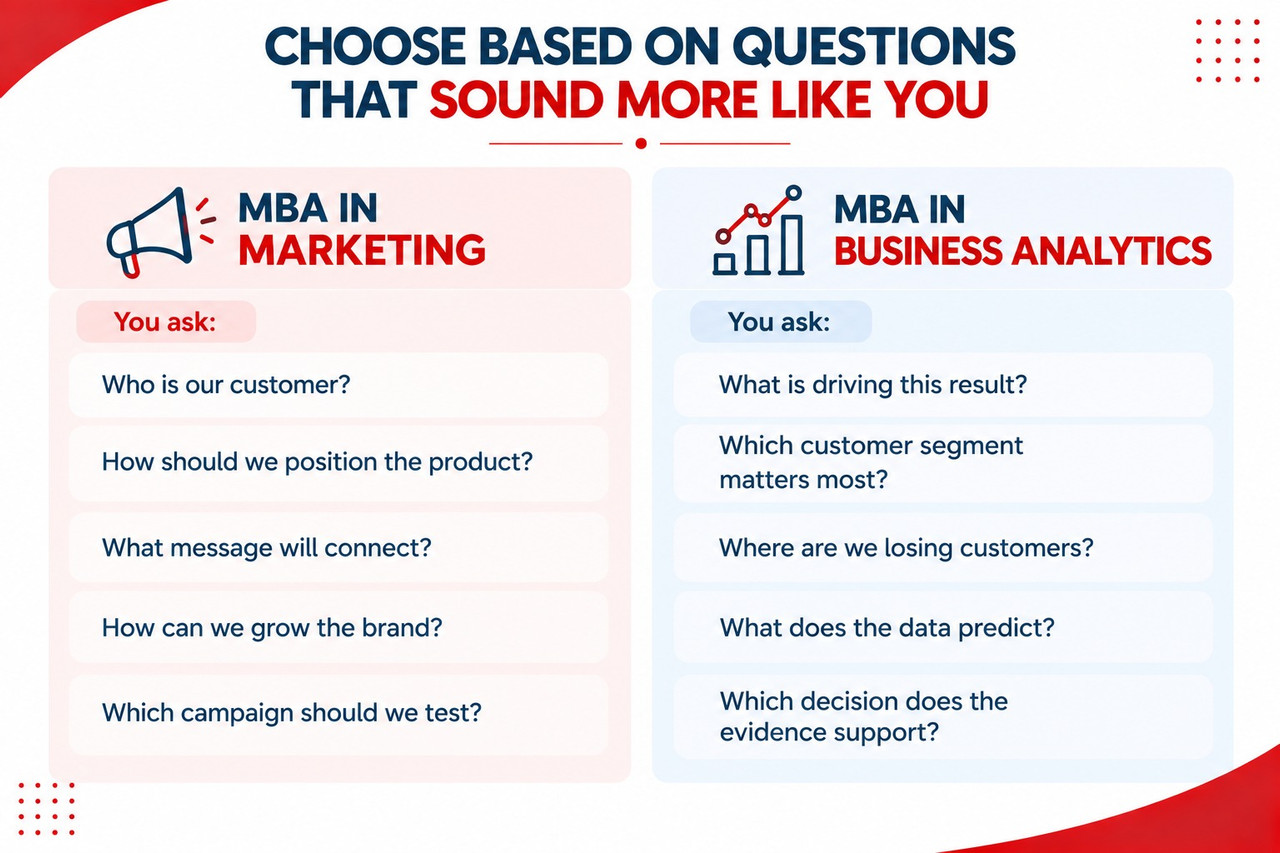
The easiest way to understand the difference is to compare the questions each professional is likely to ask.
Customer acquisition vs customer insights
Marketing asks:
How do we reach the right customer?
Analytics asks:
What does our customer data tell us?
For example, a marketing professional may work on attracting first-time buyers, while an analytics professional may identify which customer groups are most likely to return.
Campaign strategy vs data interpretation
Marketing focuses on what to communicate, where to communicate it, and how to position the product.
Analytics focuses on what happened, why it happened, and what the data suggests should happen next.
Brand growth vs business decisions
Marketing can focus on awareness, positioning, engagement, and customer growth.
Analytics can focus on forecasting, measurement, optimisation, and decision support.
Creative thinking vs analytical thinking
Marketing often requires storytelling, customer understanding, and creative problem-solving.
Analytics requires structured thinking, data interpretation, and the ability to find meaningful patterns.
But these are not strict boundaries.
A strong marketer needs analytical thinking. An analytics professional needs business judgment and communication skills.
Can Marketing and Business Analytics lead to similar careers?
Sometimes, yes.
This is one of the most important things to understand before choosing between them.
An MBA in Marketing could move into performance marketing, customer insights, or growth roles where data is central to decision-making.
Similarly, someone with an MBA in Business Analytics could move towards product, growth, or customer strategy if they develop strong communication and business skills.
How KL University approaches management learning
For students evaluating an MBA in Marketing or an MBA in Business Analytics, the learning environment can make a significant difference.
KLU offers:
- Updated curriculum with 20% of it taught by industry experts
- 1400+ faculty members, with 750+ PhDs
- 350+ smart classrooms, 100+ labs, a digital library
- Case-based learning, projects, industry exposure, and internships
- 92+ global tie-ups
- 100% placements
- Hobby clubs and technical fests for overall development
No matter what you choose between an MBA in Marketing and an MBA in Business Analytics, these factors are extremely important.
FAQs
Is an MBA in Marketing better than an MBA in Business Analytics?
Neither is universally better. Marketing can suit students interested in customers, brands and growth, while analytics can suit those interested in data and evidence-led decisions.
Can I move to analytics after an MBA in Marketing?
Yes. Marketing professionals can build analytical skills through projects, tools, and experience in areas such as performance marketing, customer insights, and marketing analytics.
Can I move to Marketing after an MBA in Business Analytics?
Yes. Analytics professionals can move towards growth, product, customer insights, and performance marketing roles by developing customer understanding and communication skills.
What should I consider before choosing an MBA specialisation?
Compare the curriculum, practical learning, internships, industry exposure, faculty, and career pathways. Most importantly, think about the kind of business problems you enjoy solving and then choose between an MBA in Marketing and an MBA in Business Analytics.