
How to Choose a Web Development Company in India: Checks, Questions and Red Flags
How to Choose a Web Development Company in India
To choose a web development company, define your goal and budget, shortlist three companies, test their live portfolio sites for speed, confirm you will own the domain and files, and compare itemised quotes. Then score each company and pick the clearest, most reliable one.
A wrong website partner costs you money, time and leads. This guide shows you how to choose a web development company in India with simple checks, the right questions to ask, and the red flags that should make you walk away.
How to Choose a Web Development Company: The Quick Answer
If you are short on time, follow these five steps:
- Write down your goal (leads, sales, admissions or bookings) and your budget.
- Shortlist three companies and open their live portfolio sites.
- Test those sites for speed and mobile use.
- Ask about ownership, support, timeline and a written contract.
- Compare quotes line by line, then score each company.
The rest of this guide explains each step in detail.
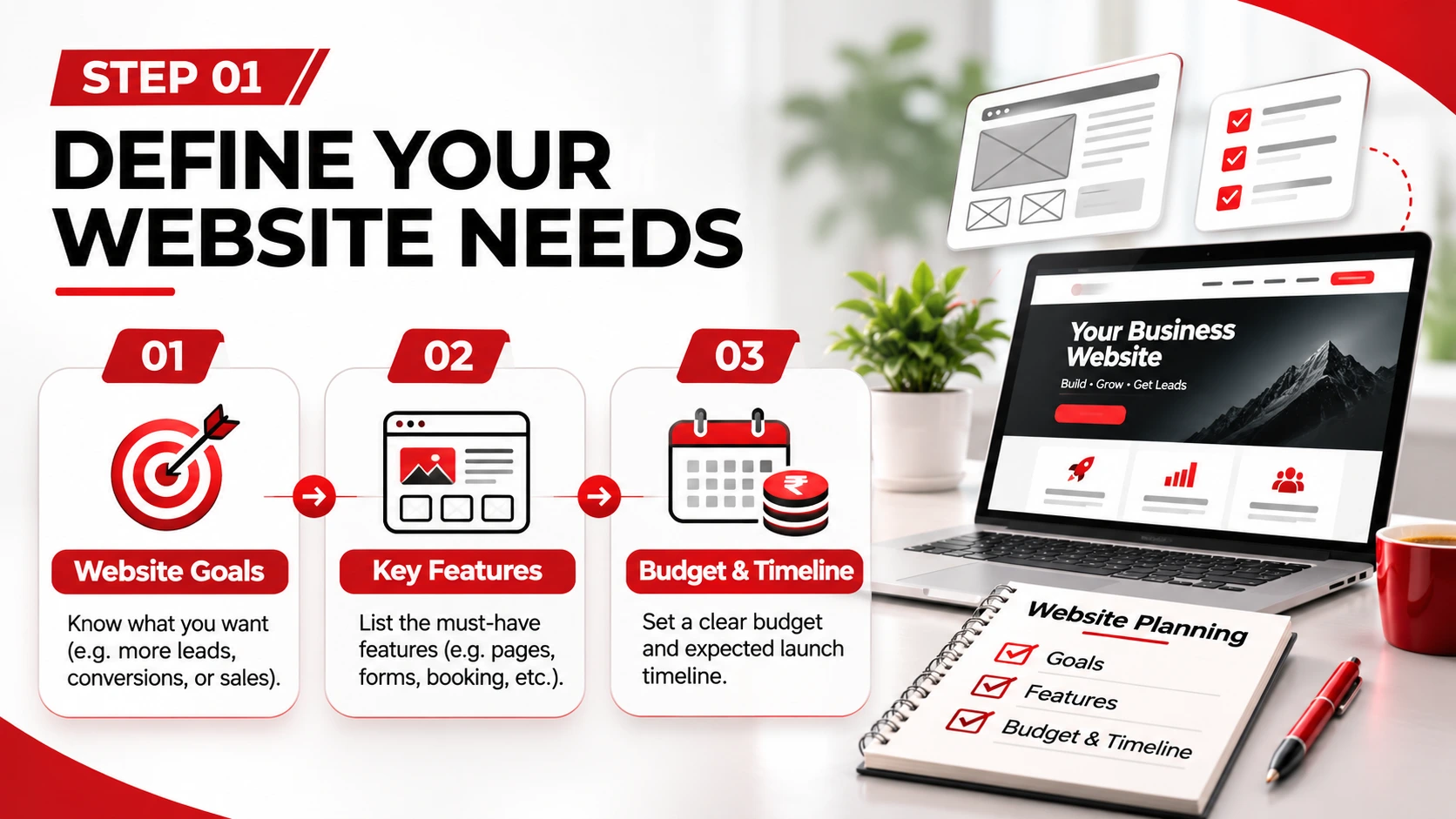
Step 1: Decide What You Need Before You Choose a Web Development Company
Most bad projects start with a vague brief. “Make me a good website” is not a brief. Decide three things first:
- Goal: What should the site do? Get calls, sell products, collect admission enquiries?
- Pages and features: How many pages? Do you need online payment, a blog, a student login or a booking form?
- Budget range: Even a rough range helps a company suggest the right option.
Your business type also changes what matters most:
| Business type | What to prioritise |
|---|---|
| Coaching institute or academy | Fast mobile pages, enquiry forms, course pages, WhatsApp button, LMS if you teach online |
| Clinic or doctor | Trust pages, appointment form, local SEO setup, clear contact details |
| E-commerce store | Product pages, UPI and card payments, inventory, speed, easy checkout |
| Local service business | Click-to-call, Google Maps link, service pages, reviews |
| B2B company | Case studies, lead forms, landing pages, clear service pages |
If you plan to run ads later, tell the company now. A landing page built for Google Ads is different from a basic brochure page.
7 Checks to Choose a Web Development Company in India
These checks take less than an hour in total. Do them for every company on your shortlist.
1. Open Their Portfolio Sites Yourself
Screenshots prove nothing. Ask for live links, then open them on your phone.
- Does the site load quickly?
- Is the text easy to read without zooming?
- Do buttons and forms work?
- Do all the sites look different, or are they the same template with new colours?
Pick a project similar to yours. A company that built a good school site may still struggle with an online store.
2. Test Their Website Speed
Paste a portfolio link into Google PageSpeed Insights. It is free. Look at the mobile score and the Core Web Vitals result. You can read what these measures mean on web.dev.
Do not expect a perfect 100 on every site. Heavy image sliders and plugins lower scores. But if every portfolio site is very slow, that tells you how the company works.
3. Check the SEO Basics
A site that cannot be found on Google wastes your money. Ask what is included at launch:
- Clean page titles and meta descriptions
- Proper heading structure
- Mobile-friendly layout
- Image compression
- XML sitemap and robots file
- Redirects from your old pages, if you are rebuilding
Google publishes a free SEO starter guide. Read it once so you know what to ask. Basic setup is normal for a web team. Ongoing ranking work is a separate service. Our SEO services in Jaipur page explains that difference.
4. Match the Platform to Your Business
A good company recommends a platform based on your needs, not on what is easiest for them.
- WordPress: Good for business sites, blogs and many small stores. Easy to update yourself.
- WooCommerce: Suits stores that want more control and already use WordPress.
- Shopify: Good for stores that want quick setup and built-in checkout. Read our guide on Shopify website development services for cost and features.
- Custom code: Needed for complex apps and special features. It costs more and takes longer.
Ask: “Why this platform for my business?” A clear reason is a good sign.
5. Confirm You Will Own Everything
This is the check most buyers skip. Ask in writing:
- Will the domain be registered in my name?
- Will I get hosting and admin login details?
- Will I get the source files and a full backup at handover?
- Who owns the design, images and content?
If the company keeps the domain or logins, you are locked in. Leaving them later becomes hard.
6. Talk to Past Clients
Ask for two or three clients you can call or message. Ask simple questions: Was the work on time? Did the company reply fast? What happened when something broke?
Also check Google reviews. Remember that reviews on the company’s own site are chosen by the company. Look for independent ones too.
7. Check Support After Launch
Websites need updates, backups and security fixes. Ask:
- Is there a free bug-fix period after launch?
- What does a maintenance plan cost?
- How fast do you reply to a problem?
- Who do I contact: one person or a ticket system?
Questions to Ask a Web Development Company Before You Hire
Use these on your first call. Notice how clearly they answer, not just what they say.
About the project
- Who will work on my project, and who is my single point of contact?
- How long will the design and development take?
- What do you need from me, and by when?
- How many rounds of changes are included?
About the build
- Which platform will you use, and why?
- Will the site be mobile-friendly and tested on real phones?
- How do you handle speed and security?
- Can I update the content myself?
About money and contract
- Is the quote itemised? What is not included?
- What are the payment milestones?
- Will I get a proper GST invoice?
- What are the yearly costs for domain, hosting and plugins?
About after launch
- What support is free, and for how long?
- If I want to leave, how do I get my files and logins?
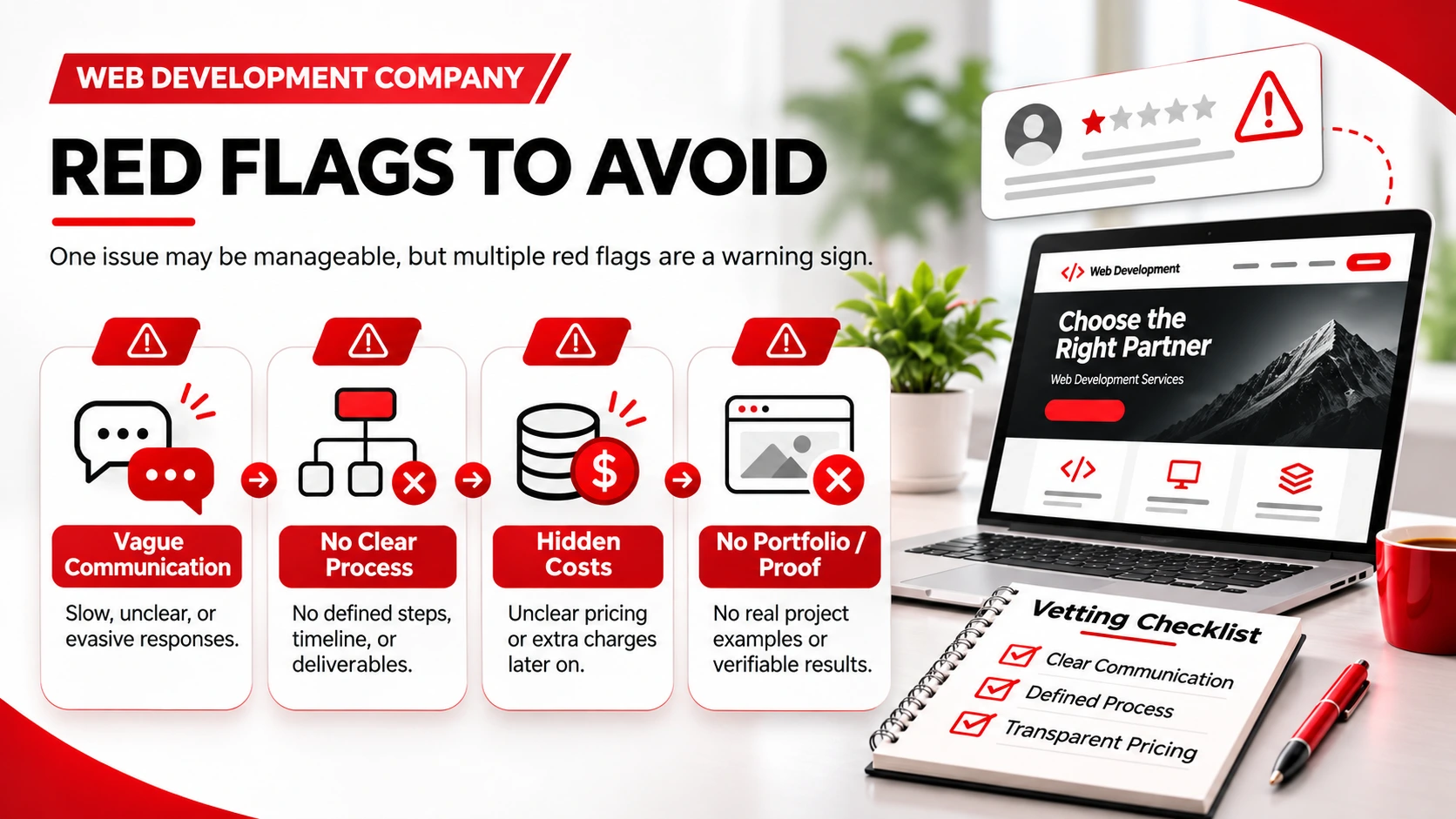
Web Development Company Red Flags to Avoid
One red flag may be a misunderstanding. Three or more is a clear warning.
| Red flag | Why it hurts you |
|---|---|
| No live portfolio, or only screenshots | You cannot check real work |
| Price far below every other quote | Corners get cut, or extra charges appear later |
| One lump-sum price with no breakdown | You cannot compare or control scope |
| Promises of “No. 1 on Google” with the site | Nobody can guarantee rankings |
| Slow replies before you pay | Support after payment will be worse |
| No written contract or a vague one-pager | No protection if deadlines or quality fail |
| Company keeps your domain or hosting login | You are locked in |
| Same template for every client | Your brand will look like everyone else |
| Pressure to pay full amount upfront | High risk of non-delivery |
| Cannot explain the work in simple words | Often means weak understanding |
How to Compare Quotes From Web Development Companies
Two quotes can look similar but cover very different work. Put them side by side and check:
- Number of pages: Is it 5 pages or 15?
- Design: Custom design or a ready template?
- Features: Forms, payment gateway, blog, multi-language, speed setup.
- SEO setup: What is actually included?
- Content and images: Who provides them? Stock images and copywriting can cost extra.
- Revisions: How many rounds?
- Timeline: A basic website often takes around 2 to 4 weeks, while an advanced or e-commerce site can take 6 to 8 weeks or more.
- Yearly costs: Domain, hosting, SSL, premium plugins, maintenance.
Set the cheapest quote aside for a moment and ask what is missing from it. Then look at the price range for your type of site. Our guide to website development cost in Jaipur in 2026 explains what drives the price up or down.
Freelancer vs Web Development Company
Neither is always better. It depends on your project.
- Freelancer: Can work for a small site or a quick fix. Often lower cost. The risk is that one person handles design, code, SEO and support. If they get busy or leave, your project stops.
- Web development company: A team covers design, development, testing and support. It usually costs more but gives more continuity.
- Rule of thumb: For a simple 3 to 5 page site, a trusted freelancer can work. For an online store, a booking system or a site tied to ads and SEO, a team is safer.
Does Location Matter When You Choose a Web Development Company in India?
Not as much as people think. Video calls, WhatsApp and shared project boards make remote work normal. A company in another city can serve you well if communication is clear.
A local company has one real advantage: you can meet in person and they understand your market. If you are in Rajasthan, a team in Jaipur is easy to visit. If you are in Mumbai or Delhi, check the same things: live portfolio, contract, ownership and support.
Pay attention to the point of contact and time zone for international clients too. Fast, clear replies matter more than the city.
Scoring Sheet: Choose a Web Development Company in 10 Minutes
Give each company a score from 1 to 5 in every row. Multiply by the weight. The highest total is usually your best fit. You can change the weights to suit your priorities.
| Factor | Weight |
|---|---|
| Live portfolio quality and similar work | x3 |
| Speed and mobile test results | x3 |
| Clear, itemised quote | x2 |
| You own domain, hosting and files | x3 |
| Communication during the sales stage | x2 |
| Client references and reviews | x2 |
| Support after launch | x2 |
| Contract and payment terms | x2 |
This sheet will not replace your judgement. But it stops you from choosing the most confident salesperson instead of the best team.
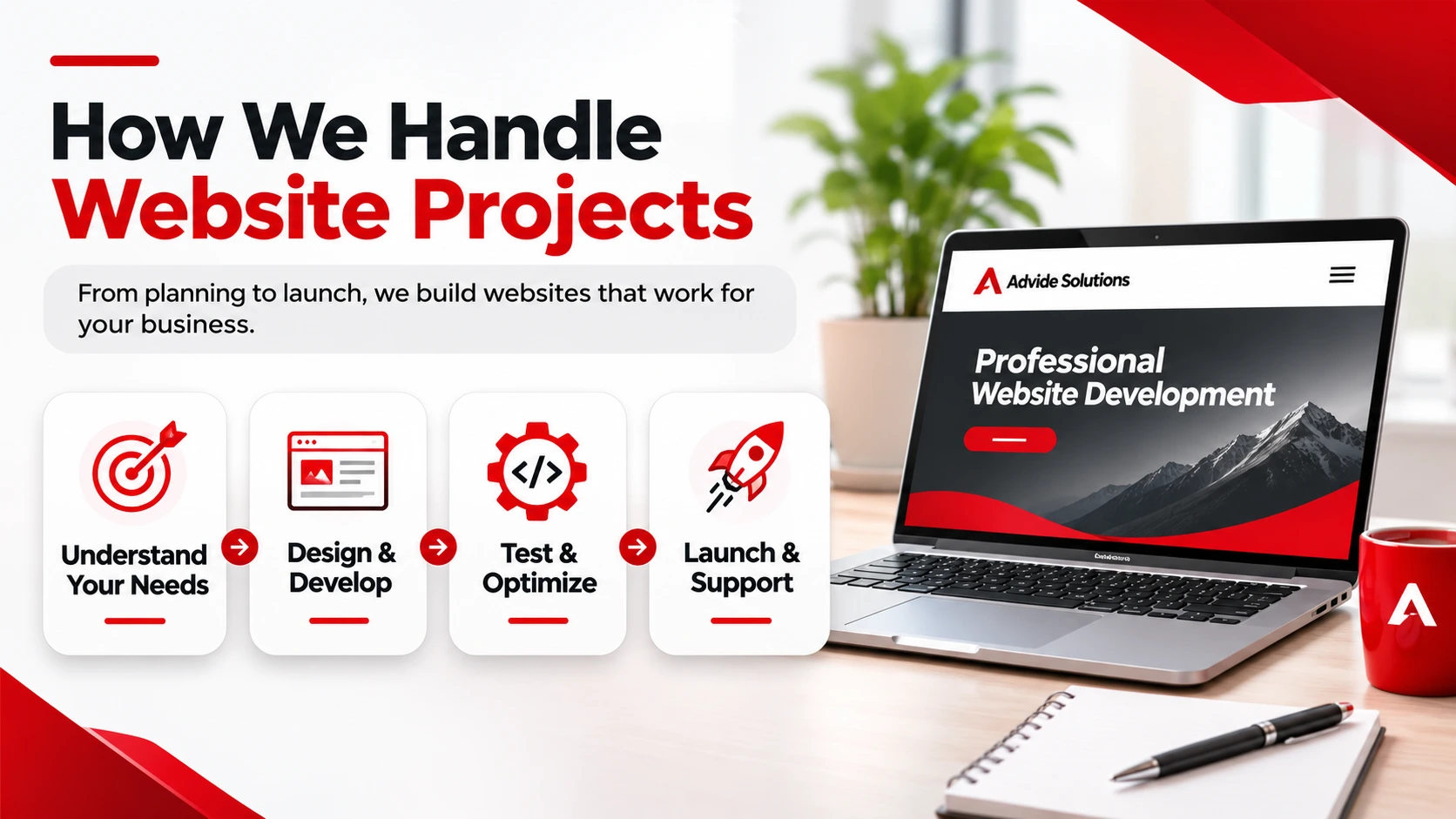
How Advide Solutions Handles Website Projects
We are a Jaipur-based digital marketing agency, and our website development service covers business websites, WooCommerce and Shopify stores, blogs, landing pages, LMS sites for educators, directory sites, news sites and NGO sites. Here is how that maps to the checks above:
- We build responsive, mobile-friendly sites with a CMS such as WordPress, so you can update content without technical help.
- We share a timeline up front: usually 2 to 4 weeks for a basic site, and 6 to 8 weeks or more for e-commerce or custom builds.
- We build for speed and SEO, and our local SEO and Google Business Profile service can support you after launch.
- If you teach or run an institute, our guide on SEO for coaching institutes shows how a site can bring admission enquiries.
We work with clients across India. If you want to talk through your project, contact our team. We will answer the same questions listed in this guide.
Final Thoughts on How to Choose a Web Development Company
The best web development company for you is not the cheapest or the biggest. It is the one that understands your goal, shows live proof, gives a clear quote, lets you own your site and stays reachable after launch.
Run the seven checks, ask the questions, watch for red flags and score each option. If you do that, you will make a decision you can defend.
FAQs
How do I choose a web development company in India?
Define your goal and budget, shortlist three companies, open their live portfolio sites, test speed on mobile, ask about ownership and support, and compare itemised quotes. A written contract and clear communication are essential.
What questions should I ask before hiring a web development company?
Ask who will work on your project, how long it will take, which platform they will use and why, what the quote includes, who owns the domain and files, what support is free after launch, and what yearly costs to expect.
How much does a website cost in India?
The cost depends on the number of pages, design type, features and platform. A simple business site costs far less than an e-commerce store or custom build. Ask for an itemised quote and compare what is included, not just the total.
Should I hire a freelancer or a web development company?
For a small site with a few pages, a trusted freelancer can be enough. For online stores, booking systems or sites tied to ads and SEO, a company with a team gives more continuity and support.
How long does it take to build a website?
A basic website often takes about 2 to 4 weeks. An advanced or e-commerce website can take 6 to 8 weeks or more. The timeline depends on features and how quickly you share content and feedback.
Who should own my domain and hosting?
You should. Ask for the domain to be registered in your name and for admin logins at handover. This keeps you free to change companies later.
Is it safe to hire a web development company in another city?
Yes, if you check their live work, sign a written contract and agree on clear communication. Video calls and project tools make remote work practical.
What are the biggest red flags when hiring a web development company?
No live portfolio, an unusually low price, no itemised quote, no written contract, promises of guaranteed Google rankings, and a company that keeps your domain or logins are the main warning signs.