
SEO for Cryptocurrency: Index Useful Pages, Not URL Clutter
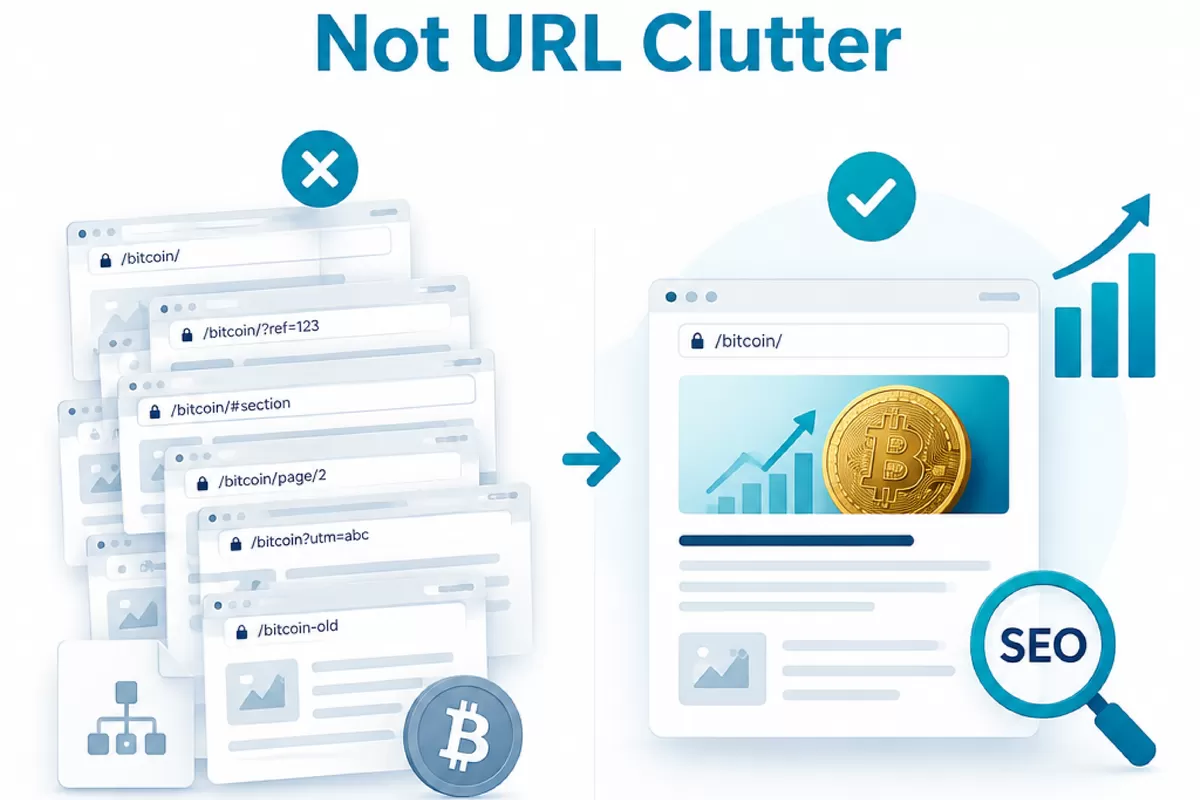 For a cryptocurrency site serving readers in the United States, a market-data section can grow faster than its search value. Each coin, trading pair, exchange, filter, and time range may create another URL. Some deserve to appear in search. Others are near-duplicates or temporary views that add little for a searcher.
Good seo for cryptocurrency starts with a page-level decision, not a rule to index every URL or block an entire data section. Decide which pages answer distinct queries, make those pages useful without relying on fragile scripts, and check that search engines can see current data. This approach helps teams manage crawl activity while keeping valuable market pages eligible for search.
SEO for cryptocurrency: Decide which market pages deserve indexing
Start with the search task each page serves. A page for Bitcoin in US dollars may meet a clear need for someone checking the BTC/USD price, recent movement, and market context. A page that differs only by a sort order or an arbitrary display setting may not offer a separate answer. The URL itself is not a reason to index a page.
Build an inventory of URL types before changing indexation. Include coin pages, trading-pair pages, exchange-specific pages, and URLs created by filters or parameters. For each type, record its purpose, whether it has distinct data, and whether users arrive through search or site navigation. Then use a consistent decision test:
- Distinct demand: Is there a recognizable search need for this coin, pair, or market view? In US search patterns, USD-denominated pairs can be meaningful page types, but each still needs a clear purpose.
- Distinct content: Does the page provide information that is not simply a copy of another page with a different label?
- Stable destination: Is this a lasting page, or is it a temporary filter state that may disappear or change?
- Useful experience: Can a visitor understand the asset or pair, read the displayed data, and find relevant related information?
A page does not need a long article to be useful. It does need enough context to explain what the data represents. A coin page might identify the asset, show its current market data with a clear update time, and link to relevant pairs. A pair page should make both assets and the quote currency clear. Avoid adding generic paragraphs just to make a page look fuller.
Control thin and near-duplicate market URLs
URL sprawl often comes from parameters. Sorting, date ranges, currency display, pagination, and filters can create many addresses for what is essentially one page. First identify which parameters change the page’s main purpose and which only adjust how a visitor views the same data. A different pair may warrant its own URL; changing a table sort from price to volume usually does not.
For each URL group, choose a clear treatment. Keep distinct, useful pages available for indexing. For alternate versions that should consolidate, use a canonical tag pointing to the preferred URL, provided the pages are genuinely equivalent. For temporary or low-value views, prevent them from becoming prominent through internal links and sitemaps. Robots.txt can limit crawling, but it does not remove a URL from search results by itself, so do not use it as a substitute for an indexation plan.
Also check internal linking and XML sitemaps. Link to the market pages you want search engines and users to find. Keep those preferred URLs in the sitemap, and leave out parameter combinations that are not intended as search landing pages. If a page is retired, choose a relevant replacement when one exists. A redirect to an unrelated destination can confuse users and search systems.
For example, a site might have a primary ETH/USD page, plus versions with a 24-hour filter, a different sort order, and a selected chart interval. The primary pair page can be the search destination if it covers the core intent. The filtered views can remain useful interaction states without each becoming a separate indexable result. Confirm that the canonical, internal links, and sitemap all point to the same preferred version.
Check dynamic market data before and after indexing
Market pages often update in the browser after the initial page loads. That can work for visitors, but it creates a verification task: check what a crawler can access, not only what appears in your own browser. Inspect the rendered page and confirm that the main content, pair name, price context, and update time are available. If the first response is mostly an empty shell, search engines may have less useful content to process before scripts run.
Price values change frequently, so a momentary mismatch between a crawler’s snapshot and the latest quote is not automatically a technical failure. More important is whether the page clearly labels the data and whether the content is still meaningful when values refresh. Show a timestamp or another clear indication of recency where appropriate. Avoid presenting stale values as current, and make error or unavailable states understandable rather than leaving blank fields.
Test a sample from each page type after template or data-pipeline changes. Check that the intended URL returns successfully, the title and canonical are correct, key market details render, and links to related pages work. Review index coverage and crawl patterns over time, then compare the results with your original URL inventory. If unwanted parameter URLs keep appearing, trace the internal links or sitemap entries creating them instead of repeatedly removing individual URLs.
Index the market pages that meet a distinct need. Treat every other URL as a deliberate product or technical choice, not an automatic search landing page.
Outside help can be useful when ownership is split between SEO, product, and engineering, or when changes to templates affect thousands of URLs. A review should clarify the page types, indexation rules, and checks needed to verify changes, rather than promise rankings. SEO Deep Insights works across SEO, answer-engine, and generative-engine optimization, and invites teams to request a free proposal with a practical next step within 24 hours.
Before making a broad change, document the preferred URL for each page type and test the plan on a small set. Confirm that useful coin and pair pages remain discoverable, duplicate views are controlled, and dynamic content is accessible. For financial decisions, market data pages are informational and should not be treated as personalized investment advice.